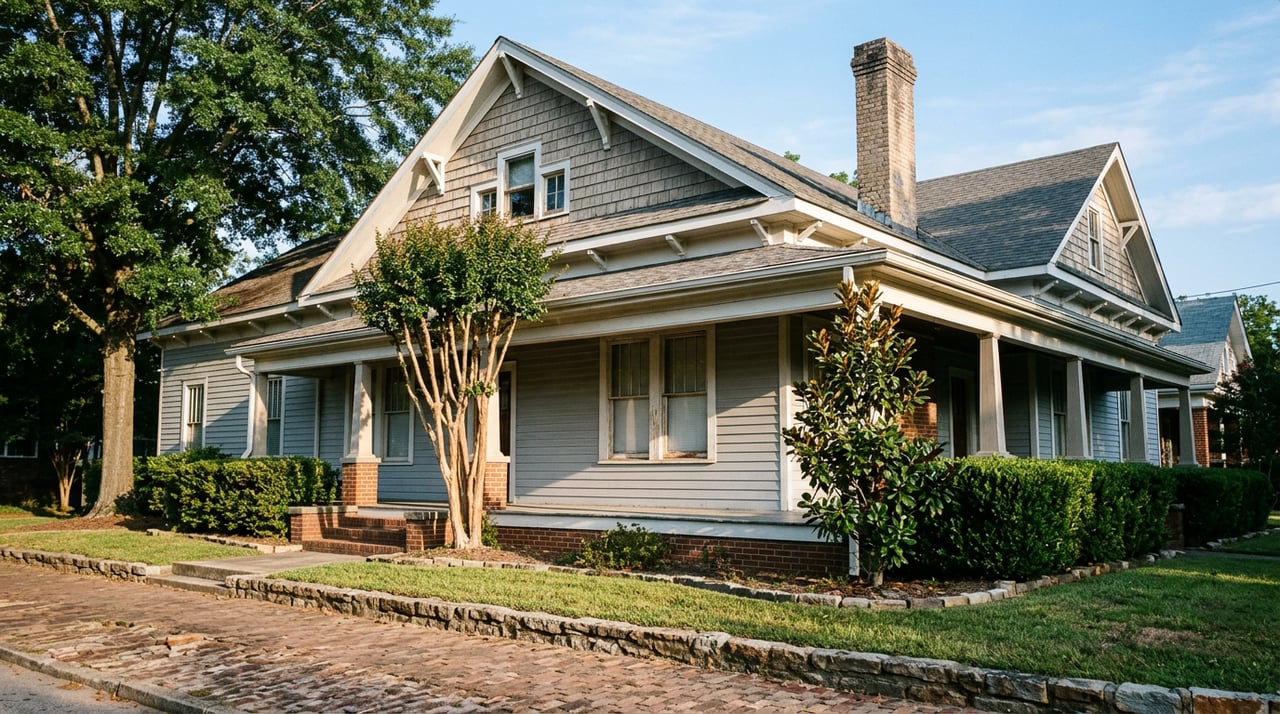
Every seller getting ready to list a hundred-year-old house in Grant Park has heard the warning: you're in a historic district, so expect a fight over the paint color, the porch railing, the new roofline you wanted to add. That warning is mostly wrong, or at least overstated. The city's own zoning language for Grant Park's main residential area says a Certificate of Appropriateness is not required for most work here. Applications go to the commission for review and comment, not a formal approval gate.
The thing that actually stalls a closing rarely shows up in a design review. It shows up three weeks into a contract, when the buyer's insurance agent asks a question the seller never thought to ask: what kind of wiring is in these walls.
What the Historic District Actually Regulates
Grant Park's historic district was designated on April 11, 2000, and it covers the neighborhood's grid of narrow lots, its brick sidewalk fragments, and a housing stock that runs from Queen Anne and Folk Victorian homes near the park perimeter to Craftsman bungalows on the surrounding blocks. The district's own regulations, found in Chapter 20K of the city's zoning code, do not require a Certificate of Appropriateness for ordinary work in Residential Subarea I, where most of the neighborhood's houses sit. Type II review applies to specific items like façade alterations facing a public street, fences, and accessory structures. Painting and repainting needs no review at all.
That is a meaningfully lighter framework than the generic warning most sellers repeat to each other, which treats the historic district as a blanket approval process for anything touching the exterior. It isn't. What the district does firmly restrict is demolition and new construction, along with visible material choices on street-facing façades: no unfinished concrete block foundations, no black asphalt paving, no stacked stone veneer. If you're repainting a porch or replacing a water heater, you're not walking into a commission hearing.
Where the real friction shows up is in a place sellers rarely think to check before they list.
The Friction That Actually Kills a Deal
Grant Park's housing stock was built mostly between the 1890s and 1940s. A meaningful share of that stock still carries its original knob-and-tube wiring, a system designed for a handful of light fixtures and rated for 30 or 60 amp service, not the 200 amp load a modern kitchen and HVAC system draws today.
Insurance carriers in Georgia have gotten stricter about this. Multiple licensed electrical contractors working the Atlanta market report that major insurers now decline to write new policies on homes with active knob-and-tube wiring, or require documented remediation before binding coverage. That distinction matters because the buyer's insurance binder, not the historic commission, is what the lender needs in hand before closing.
Here's how that plays out in practice. A buyer goes under contract on a Grant Park Victorian. Their lender requires proof of homeowner's insurance before closing. Their insurance agent runs the property and flags the wiring type, either from disclosure or from an inspection report. If the carrier won't bind a policy on active knob-and-tube, the buyer now has two options: find a smaller pool of carriers willing to write a higher-premium policy, or push the seller for a credit to cover a rewire, or walk. None of that involves the Urban Design Commission. All of it involves a due diligence clock that started ticking the day the contract went binding.
The historic district tells you what you can build. Your insurer tells you what you can actually sell.
This is not a hypothetical limited to pre-1945 construction. Homes built between 1965 and 1973 elsewhere in the metro sometimes carry aluminum branch circuit wiring, a different but related insurance flag, though Grant Park's housing predates that window by decades in most cases.
What the Numbers Actually Say Right Now
As of June 2026, homes in Grant Park have been selling at a median price of approximately $570,000, with an average price of roughly $345 per square foot. Homes are averaging about 41 days on market, down from around 54 days the year before. That compression matters for sellers weighing whether to fix wiring before listing or after: a faster market gives you less runway to discover and resolve an insurance problem mid-contract than a slower one did twelve months ago.
Pricing splits sharply by condition and location within the neighborhood.
| Housing segment | Typical price range | What it tells a seller |
|---|---|---|
| Entry-level bungalow, needs work | $400,000 to $550,000 | Buyers here often expect to inherit older systems, but many still need financing that requires an insurance binder |
| Neighborhood median | approximately $570,000 | June 2026 figure; blends both ends of the range |
| Renovated Victorian near the park | $1,050,000 to $1,250,000 | Higher price point buyers are less tolerant of post-contract surprises on systems |
Active inventory sits around 54 listings, enough to give buyers options without the extreme scarcity that defined the intown Atlanta market during 2021 and 2022. That means a listing with an unresolved wiring or insurance flag doesn't just risk one buyer walking. It risks sitting while comparable, cleaner listings move faster.
The Other Things That Show Up in an Inspection
Wiring is the item most likely to touch insurance underwriting directly, but it isn't the only system-level issue that surfaces in a Grant Park inspection report. Atlanta sits on red clay soil that expands and contracts with seasonal moisture, which produces stair-step cracking in brick veneer and foundation movement that an inspector unfamiliar with the region can miss or misread. Older cast-iron and Orangeburg sewer lines, common in homes built before 1990, are vulnerable to root intrusion from the mature oaks that give Grant Park its canopy. A sewer scope on a pre-1990 home is not optional due diligence. It's the difference between a $200 camera inspection and a five-figure line replacement discovered after closing.
None of these are historic district issues either. They're building-age issues that happen to concentrate in neighborhoods where the building stock is old, which describes most of Grant Park.
A Sequence That Avoids the Late Surprise
Sellers who get ahead of this timing problem generally work through the same short sequence before they list:
- Have a licensed electrician assess the wiring, specifically checking for active knob-and-tube, before the home goes on the market rather than after an offer.
- If the home predates 1990, get a sewer scope done proactively so root intrusion or line deterioration is known and priced, not discovered during a buyer's due diligence period.
- Pull together documentation of any prior rewiring, panel upgrades, or permitted plumbing work. Buyers' insurance agents move faster with paperwork in hand.
- Confirm the property's actual historic subarea status through the city's GIS tools rather than assuming a blanket COA requirement. Knowing what is and isn't restricted saves time if you're doing any pre-listing cosmetic work.
- Price the listing with the insurance and systems picture already resolved, rather than banking on a buyer's tolerance for post-contract negotiation.
FAQ
Does every exterior change in Grant Park require a Certificate of Appropriateness? No. The district's Residential Subarea I regulations state that COAs are not required for most work. Applications go to the commission for review and comment, and specific items like repainting need no review at all. Demolition, new construction, and certain façade-facing changes carry more scrutiny.
If my home has knob-and-tube wiring, will a buyer's insurer definitely deny coverage? Not universally, but many major carriers in Georgia either decline new policies on homes with active knob-and-tube wiring or require documented remediation first. Some will write a policy at a higher premium. The safer assumption for a seller is that it will raise a question during underwriting, not that it will be ignored.
How long does a rewire typically take if I want to address this before listing? Licensed electricians working in the Atlanta market generally describe a whole-house rewire as a matter of days of on-site work, though scheduling, permitting, and any drywall repair can extend the total timeline. Getting an assessment early gives you room to plan around it rather than reacting to it mid-contract.
Grant Park's charm was never in question. What's changed is how quickly that charm gets tested by an underwriter who has never walked the neighborhood and doesn't care about the porch. If you're weighing when to list a historic Grant Park home, Golley Realty works this market block by block and can help you sequence the pre-listing work so it doesn't become a mid-contract scramble. Talk to a Decatur Neighborhood Expert before you put a sign in the yard.
